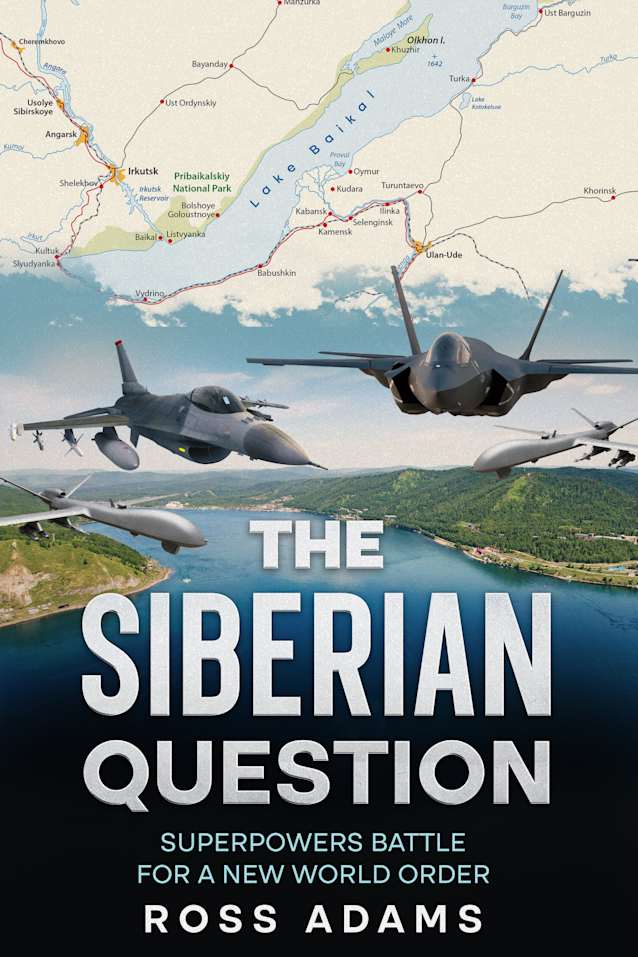
The Siberian Question
About
Rated 8.75 out of 10 by The BookLife Prize, sponsored by Publishers Weekly. Plot/Idea: 10 out of 10.
2026 BookFest Featured Author.
2026 Chanticleer Global Thriller Awards Long List.
"Feels both believable and remarkably relevant."
- The BookLife Prize
A prequel toThe Price of Water, the geopolitical thriller readers called "disturbingly plausible," "compulsively readable," and "less like fiction than a classified briefing."
Before water becomes the world's most valuable commodity, before global systems fracture under environmental and political strain, there is The Siberian Question.
In this tense and meticulously researched prequel, Ross Adams traces the origin of the crisis, and the beginnings of a solution, that later define The Price of Water. As Russia weakens, China advances patiently while the West misreads the moment. Siberia, vast, resource-rich, and demographically transforming, emerges as the fulcrum on which the future world order will turn.
Through the eyes of intelligence officers, political leaders, and operatives embedded deep inside rival systems, The Siberian Questionreveals how long-term strategy, economic dependency, migration, and climate pressure quietly align into something irreversible. What appears at first as regional instability becomes the opening move in a global realignment that no nation is prepared to stop.
Readers praised The Price of Water for its realism, clarity, and chilling sense of inevitability. The Siberian Questiondeepens that realism, showing how such a future does not arrive suddenly, but is constructed, step by step, by rational actors making logical choices in an unforgiving world.
The Siberian Questioncan be read as a standalone geopolitical thriller, but it also forms the foundation of The Price of Water, revealing the strategic origins of the geopolitical world order in which the crisis that will soon engulf the globe takes place.

Praise for this book
Ross Adams took us to the next level with this one! The characters can be unnerving and highly believable political animals. Take a trip to a side of Russia and China that you would never think so important to world power. Intriguing read. D McQuade
I like the espionage, geo-political intrigue and characters of Tom Clancy, Vince Flynn, Jack Carr, W.E.B. Griffin and Ted Bell...this book was terrific! Thought-provoking, fast-paced and well-written. This book brings into focus the potential challenges we will face in the near-future in a very entertaining way. When I don't want to put a book down, then I know it is.
Great story telling with provocative, and realistic, prognostications!
I used to love to read but over the years, I've gotten away from reading as much as I did in the past. Thank you for your brilliance in authoring The Siberian Question. There is no question about your ability to paint a picture, describe characters and places, and your uncanny way of leading us into a building story. Although I am not finished yet, I am thoroughly captivated by your work. I can't wait to finish this one and begin to build a library of anything else you write.
I've been trying to figure out how to describe The Siberian Question to people who haven't read it, and the best I've managed is this:
It's a geopolitical thriller written by someone who actually understands geopolitics.
That sounds like it should be a low bar. It turns out it's quite high.
Ross Adams is a practicing attorney — international IP, business litigation — with a Princeton history degree and a decade of firsthand experience building companies in post-communist Prague and Warsaw during the 1990s transformation. He watched institutions scramble to keep pace with a world reorganizing faster than anyone had planned. He watched legal frameworks lag behind power shifts. He watched what happens when leverage forms before anyone names it a crisis.
That's the book. That's the entire book.
The scenario: Russia controls approximately 20 percent of the world's unfrozen freshwater at Lake Baikal. China's water table is in documented long-term structural decline. The gap between those two facts is where geopolitical leverage is forming — quietly, legally, below the threshold of alarm. The novel asks what happens when someone decides to use that gap.
What makes The Siberian Question different from most political thrillers is that it's set not in the crisis but in the interval before the crisis — when the world still looks stable to the people making decisions inside it. The reader can see what's coming. The characters can't. That gap — between reader knowledge and character understanding — is where the book lives from page one, and it creates a specific kind of dread that stayed with me long after I finished.
The legal and corporate mechanisms in the novel are specific in a way that most fiction doesn't attempt. Ownership structures. Access agreements. Regulatory arbitrage. The way leverage gets encoded in legal frameworks that outlast the people who built them. None of this is invented. Adams applies documented patterns to a near-future scenario, and the result is a book that doesn't feel speculative so much as diagnostic.
I read it in three sittings. The last fifty pages I read without putting it down.
The second book in the series — The Price of Water — is set in 2051, after the scenario of The Siberian Question has run its course. Start here. Then read that.
The trajectory is real. The timeline is fiction.
BookLife Prize - 2026
Plot/Idea: 10 out of 10
Originality: 9 out of 10
Prose: 8 out of 10
Character/Execution: 8 out of 10
Overall: 8.75 out of 10
Assessment:Plot/Idea: The Siberian Question is a gripping geopolitical thriller that transforms complex global issues into an engrossing work of fiction. Ross Adams builds suspense through careful political maneuvering, intelligence operations and competing national interests. Every chapter raises the stakes as seemingly isolated decisions accumulate into an international crisis, creating a story that feels both believable and remarkably relevant.
Prose: Ross Adams writes with clarity, precision and confidence, striking an excellent balance between geopolitical analysis and engaging storytelling. The pacing remains steady throughout, with vivid descriptions that effectively convey both the harsh Siberian landscape and the high-stakes world of diplomacy and intelligence.
Originality: Rather than centering the story on battlefield combat or a single international incident, The Siberian Question distinguishes itself by exploring how global power can shift through gradual, calculated change. Ross Adams examines the intersection of demographics, resource competition, climate change, economic influence and diplomacy, crafting a thriller in which strategy is every bit as compelling as action.
Character/Execution: Adams populates the novel with a diverse cast of intelligence officers, political leaders, military commanders and civilians, each offering a unique perspective on the unfolding crisis. Rather than presenting simplistic heroes and villains, he develops characters whose motivations are shaped by national interests, personal convictions and the difficult choices demanded by international politics.
Date Submitted: June 25, 2026